Showing posts with label esl. Show all posts

Sunday, May 26, 2013

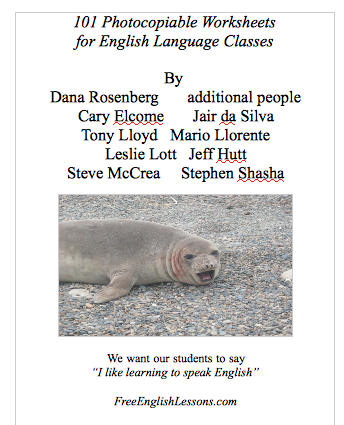
Here's one way to get invited to travel to interesting places: Ask mentors to join you in creating an ebook and then print it on Createspace.com. Then send the ebook to schools in other countries

This is an invitation to make an excellent book of worksheets.

==========================


Note to the reader who is a teacher

Have you ever had that moment when one or more of your students is done with the lesson and you can see boredom appear in their eyes?

Have you ever wished you could reach into a magic box and pull out a worksheet that would keep fast students occupied?

This is that magic box. These worksheets worked for us and we want to share them with you.

In return, we ask that you pass along these worksheets to your colleagues. Please write to us with your suggestions and if you have a mafic worksheet, please share it. We can include it in the next edition.


Send your comments and worksheets that work for you to FreeEnglishLessons@gmail.com.

The worksheets will become Creative Commons. Please assume that other teachers will adapt your work and improve their lessons. We will ask that your name is attributed to all derivations of the work.


Note to the reader who is a student

You are probably annoyed by the boring classes that you might be taking or you might be interested in accelerating your speed of acquiring English.

Step 1: Tear out this page of the book.
You can tear out this page (the words “annoyed” and “boring teacher” probably will be associated with your current school) and give the rest of the book to one of your teachers or perhaps to a principal.

Step 2: Get this book in front of a boring teacher.
It might help if you simply slip into the teacher's room and place this book on a table. Or leave it next to the photocopy machine, if your school is equipped with such a dangerous device.

Step 3: Get the ebook and share it with your friends
Research shows that studnets who work together and encourage each other often learn faster and more.

Step 4: Start your Personal Learning Plan (PLP)
You might want to show future teachers what you have already done in your classes, so that the future teachers can adapt to your plan for your success.

Step 5: encourage your classmates to start their own PLPs
Why not spread the joy of independent learning by asking your classmates to join you?

Step 6: Contact bibpenpals@yahoo.com and ask for penpals.
You might need to send a copy of your request email to FreeEnglishLessons@gmail.com because the bibpenpals email address is not monitored daily. If you have access to the Internet, you can watch videos at www.Youtube.com/bibpenpals and you can look for BIBPenpals on Facebook at www.Facebook.com/bibpenpals. You will learn to speak better if you have a native speaker working with you.


Send your comments to FreeEnglishLessons@gmail.com.

www.Facebook.com/bibpenpals


A note to directors of schools

It is a hazardous business to make suggestions to teachers. Many will nod their heads and say, “That's something I will start to do in my next class,” but really you don't know what is happening in their heads. Other teachers might make a face and eventually agree to do what you asked them to do, but you feel you need to follow up with monitoring.
www.Youtube.com/BIBPenpals
The beauty of this Photocopiable Pages approach is that the teacher doesn't need to prepare a lesson plan, since the worksheets are generally easily completed by students. If your school has access to the Internet, there are videos associated with each worksheet. Students or the teacher can switch on the video and let the class proceed. It's a way to differentiate the instruction.

If your school is plagued with teachers who lead a one-lesson-for-all approach, then the creation of portfolios and personal learning plans might be one part of the cure. Your classes will have a new culture of learning and inquiry by using this book and some of the other books in our series, including:

Building More Responsive Schools (Dr. Abraham S. Fischler),
Let's Lecture Less by Mario Llorente and S. McCrea
How can we improve schools? (the Humanistic approach) by Mario Llorente and others
Guide on the Side (in production)
The Flipped Classroom (Ask students to watch your lecture at home and arrive ready to discuss the lecture in the next class)

All of these books are available as free ebooks.


Send your comments to FreeEnglishLessons@gmail.com.


Here is the introduction to the book


There are many workbooks with effective worksheets.

Many students benefit from filling in blanks to learn the differences between past and present and subject and verb. But let’s look at the binders and folders that students carry around. What do we see?

Often we see a stack of worksheets that appear to be carried around but not looked at more than once or twice.

The goal of this packet is to give you useful worksheets that students can use again and again.  

Worksheet A
How to politely interrupt the teacher

Worksheet B
My Learning Plan

Worksheet C
Pronunciation Practice Chart

These are the three sheets that I distribute at no cost online.

I like to introduce the sheets to my students in that order. Here’s what I say:

Teacher Talk A
How To Interrupt the Teacher
I like to give my students permission to interrupt. It is an excellent skill and it communicates immediately that the class is centered around you, the students. Your best skill will be speaking. Talking is how you will quickly show people your level of English. So I want you talking. Let’s practice using this sheet…

Lower levels: It’s okay to ask questions. We want you to talk a lot. Let’s use these words…

Teacher Talk B
My Learning Plan
The learning plan is a set of goals. You can put your goals on this sheet. We can work together to find words and homework to meet your goals.

Lower levels: What do you want to do? Let’s look at each part of this page.

Teacher Talk C
Pronunciation
The learning plan is a set of goals. You can put your goals on this sheet. We can work

Lower levels: What do you want to do? Let’s look at each part of this page.

Teacher Talk (at least once a week)
Remember, students: Eventually you will not need these sheets. Eventually you will leave these sheets on a bookshelf or you’ll toss them out because you need the binder for another project. Someday, you won’t need these pages. But right now, let’s look at these pages again – what can we add? What can we review?

No Photocopier? No Problem
None of these worksheets needs to be photocopied. You can put this information on a board and the students can get the information on blank sheets of paper.

Final word to teachers:
  1. You have the “teacher talk.”
  2. You have the sheets.
Let’s get started.


==========================  

The end of the book goes like this:


There will be future editions....


Note to future contributors


This book is intended to be sold at a very small profit margin and will in fact be given away to schools in developing countries, such as Cuba.

The aim is to get the contributors (whose names will be on the cover) invitations to come to the schools.

A contributor who places some lessons in this compilation will be encouraged to send the ebook to hundreds of schools in an area that the contributor wants to visit... in exchange for a place to sleep, the contributor offers to give a workshop. Not a bad way to spend a holiday.

If you are interested in participating, send me some examples of worksheets … the aim is to make the 101 pages useful. The core of the program is the creation of a portfolio, so the items in the portfolio will help show future teachers the level of fluency that the student has attained. The portfolio will also show what areas the student has and perhaps hasn't mastered.


Steve (editor / compiler)


I hope you will participate. Let's throw together a bigger, better and more diverse collection of worksheets that teachers can use.

I think it's okay to have multiple approaches to irregular verbs in the same workbook... after all, it's an ebook. It will also be available for purchase as a 8.5 x 11 format book on Createspace.


Ending Message
Thank you for using my photocopiable worksheets in your class. Please contact me at danaroseenglish@yahoo.com. Thanks. If you have a worksheet that works for you, I hope you will let me share it in the next edition of our book.

English Language Teaching can take you from Alaska to Argentina!


A list of tips
1. Go for it and actually make it happen!
2. Relate to students on a personal level
3. Be energetic and show that you want to be there teaching
4. Have unconditional positive regard and treat mistakes as a good part of the learning process
5. Give real world examples
6. Make the activities fun and interesting

Keep in touch.


==========================

You can see the prototype of this workbook here

Learn about BIBPenpals

Tuesday, May 7, 2013

Mary Finnocchiaro's Twelve Points

Let's get this poster on walls in classrooms.


You can find this poster along with a poster using lyrics by Coolio on my gmail Drive account.

Here is the link
reproduction by a teacher or student of a small part of a work to illustrate a lesson;

Copyright is a sticky issue.  There's "fair use" in an educational setting.  Well, this blog is my classroom and you are my audience.   I'm just sharing with you in an educational "fair use" way that promotes the ideas of Mary Finnocchiaro.  Her 12 points ought to be on walls in schools.

Here's a quote:

The 1961 Report of the Register of Copyrights on the General Revision of the U.S. Copyright Law cites examples of activities that courts have regarded as fair use: “quotation of excerpts in a review or criticism for purposes of illustration or comment; quotation of short passages in a scholarly or technical work, for illustration or clarification of the author’s observations; use in a parody of some of the content of the work parodied; summary of an address or article, with brief quotations, in a news report; reproduction by a library of a portion of a work to replace part of a damaged copy; reproduction by a teacher or student of a small part of a work to illustrate a lesson; reproduction of a work in legislative or judicial proceedings or reports; incidental and fortuitous reproduction, in a newsreel or broadcast, of a work located in the scene of an event being reported.”

http://www.copyright.gov/fls/fl102.html

This post brings to your attention the life and work of a notable teacher.  You can learn more here:

http://www.tesol.org/about-tesol/tesol-awards-grants/tesol-awards-for-excellence-service/the-mary-finocchiaro-award-for-excellence-in-nonpublished-pedagogical-materials

Monday, May 6, 2013

What's your philosophy of education? I've got more than four points. (part 2)

See Part 1

The difficulty comes when i find out the current goals instead of the long term goals.

At some schools  where I've worked, the policies are convenient to the administration and the studernt is expected to adapt to the situation.

Students ask me, "Why can't i get what i want?  Why does the school offer only one way to do [this] or [that]" and I make the mistake of asking the student to look at the situation from the school's point of view and then the discussion expands and I usually ask the student to think outside the box.   "What are your options?"   That's a question that many school administrators don't want students to explore.

5.  I also arrange to meet the students after school sometime during the week, i make it optional, i try not to force the idea and I try not to exclude anyone.  

6. I also try to go on an afternoon or evening trip... $40 limosouine tour of miami beach.   oh?     why not rent a van and go together?

it's often a long night but memorable.

i say, "Why should we end at 4 hours?   after the obligatory tour of 6-10 pm, i'm off the clock but I'm happy to see that the student has good memories.   We often return after 1 a.m.

I take a longer view than some school administrators take.   Tom Peters says "one size fits all?   One size fits one or often few or none"
The policy at some schools is to keep teachers separate from students.  "Teachers deliver a lesson and then leave the school."  When the school stops paying, at the end of the class, the teacher is expected to leave the building.

Flexibility


Those are some of the procedures that I use.   

7.  The student sis the center of my classroom.  I use the CELTA technique of arranging the room so that the students see each other's faces when talking and every moment as an opportunity to practice speaking and listening.  

8. teachers speak less than 20% of the time and students are engaged -- well, they are invited to be engaged in a range of activities.

9.  The aim is to build a portfolio of experiences and a record of examples of students' work.  The portfolio shows the students what they have learned.

10.  There is a balance between (a) evidence of actual work (that is real work) and (b) getting "something" flashy produced and physically in the hand of the students within two weeks (such as an audio CD or DVD or some videos) which is like a yearbook
The "flashy" or techie item might never be looked at, but it is a sense that "I did that" and the student carries something -- perhaps a memory -- of a procedure that had real change in the brain, even if the vocabulary is forgotten.


11.  Students remember how they were treated long after they have forgotten what was actually taught or presented or practiced or produced or discussed in class.

12.  very few worksheets = "shut up" sheets
very little busy work

13.  Some students have a mindset that they want to study grammar and i'm happy to give them what they want.   I know that the level of each student is different, each has different holes, so I ask them to participate in the swiss cheese approach.  find the holes and plug them.


14.  my philosophy is one student at a time
treat all the student the same differently
(give every student some amount of attention, but the type of attention will be adapted to the expressed or anticipated needs of the person)
find their goals
build individual personal learning plans

15.  Use numbers in lists so that people can discuss the point in class "I want to talk about point number 4" and everyone in the room knows what part of the board to look at.  

16.  use dennis littky techniques


My technique is "open the book somewhere and use that quote to stimulate a discussion in class."


Here's an example of some Internet materials that might be introduced in class.

Search Results

  1. CNN Student News - CNN.com

    www.cnn.com/studentnews

  2. National and world news with background material, activities, discussion starters and teaching guides. USA.


  3. CNN Student News/Quick
    CNN Student News/Quick Guides & Transcripts. FOLLOW THIS ...


  4. Student News A to Z with Carl
    The weblog of CNN Student News.

  5. CNN Student News (video)
    CNN Student News utilizes CNN's worldwide resources to bring 


  6. CNN iReport
    Welcome to the CNN Student News iReport assignment group 
  7. Daily Discussion
    CNN Student News/Daily Discussion & Newsquiz ...


  8. April 16, 2013
    CNN Student News Transcript - April 16, 2013. updated 7:13 ...
  9. More results from cnn.com »

  10. iTunes - Podcasts - CNN Student News (video) by CNN

    https://itunes.apple.com/us/podcast/cnn-student-news.../id179950332
  11. Download past episodes or subscribe to future episodes for free from CNN Student News (video) by CNN on the iTunes Store.
  12. Carl Azuz - CNN Student News Official | Facebook
    www.facebook.com/CNNStudentNews

  13. Carl Azuz - CNN Student News Official. 89866 likes · 715 talking about this.

  14. CNN Student News | Facebook

    www.facebook.com/pages/CNN-Student-News/223024161084827


  15. CNN Student News (CNNStudentNews) on Twitter

    https://twitter.com/CNNStudentNews


  16. CNN Student News - 2/15/13 - YouTube

    www.youtube.com/watch?v=alEQN6GX2-Q
  17. Friday's edition of CNN Student News covers everything from a damaged cruise ship to an asteroid passing ...

What's your philosophy of education? I got it down to four points.

This post is dedicated to two of my favorite administrators of language schools, Tony and Leslie.  They have inspired the best in me.


Principles that I try to use in classes
a) find out what each student wants to learn
b) have an overall plan for the class
c) but serve each student when possible
d) make sure every student speaks often

Search "cnn student news"
=============  


in an English language class
find out what the students want to learn
deliver it
create a culture of learning and self-pushing
make each day a possible 

I'm re-reading Mary Finocchiaro and i like her list of twelve
a) to know intimately
the students
 and the
community in which
they live
"should"s or principles from 

I particularly like the first principle.

a) to know intimately the students and the community in which they live in order to relate new language and cultural materials to probable experiences and interests of the students.

other points... (highlights, excerpts)
b) to broaden students' experiences through discussion of music, art, hobbies and other areas of interest in the school curriculum or in the community.
c) to enrich the students' vocabulary
d) to teach as quickly as feasible the formulas of English
e) to present all new vocabulary in easily demonstrable situations
f) to exploit every language learning activity so that it will reinforce and facilitate communication
g) to proceed from tightly controlled drill to freer, more authentic creative expression from the very first day of the language program.
h) to reintroduce structures and vocabulary of high frequency as often as possible
i) to add authentic, meaningful language activities and sort, two or three line dialogues for frequent dramatization.
j) to suggest or encourage students to suggest alternative sentence sin the dialogue utterances so that they will not always expect the responses they will have learned in the original dialogue.
k) to modify the sequences and order of materials in textbooks so that questions o all kinds and the pronouns I and you are introduced and practiced very early.
l) to remember that understanding the meaning of any utterance depends on knowing its single elements of pronunciation, of grammar, of vocabulary and of culture.
Finocchiaro, pages 74-76, recommended by Mario Llorente

I post this list on the wall so students can say, "Hey, Steve, you didn't do numbers h and j today."

How does this approach translate into a class?  What procedures do I use?  What stages are set in the class?  

1.  There's a plan, a grammar point, some dialogue, pronunciation practice, an interesting reading point and something to listen to from CNN perhaps   


2. i like the studentnews transcript that is available each week

I found it easily by typing a search without spaces  "cnnstudentnews"

3. My job is to present materials for learning and then adjust to each student's needs and requests.  I'm a concierge.

4. I arrange time to meet with each person and get their goals on paper in the first day.

Other points of interest and inspiration (see part 2)