Showing posts with label posters. Show all posts

Thursday, March 19, 2015

Why not post quotes from Littky's 2004 book? Hang them where people linger... near the water cooler...

http://youtu.be/EZY9L7xYVlQ

Search for 1 of 6 Posters and Quotes from Littky's Big Picture book 2004
Littky's book could be presented to students and parents in pieces.  How about delivering a quote on a sheet of paper and posting the paper in restrooms and on walls?

Here are some examples....


Friday, April 18, 2014

Before You Go To Sleep Tonight: 365 Posters to Think About -- Thoughts after a discussion with Mario Llorente

This is a post about "how to increase blood flow to the brain."
The purpose of school is to create blood flow to the brain.  The result is a change in the brain's structure.  There will be more complex relationships in the brain.  The wiring is changed.  If there is no change in the long-term memory, then there is no learning.  If something is placed in the WORKING memory, I often stop, thinking, "Oh, good, I did my job, I got the students to learn something."

If the students can't produce that thing six months later, do I get penalized?  Not often.  There are no real consequences.  "Oh, we need to review that... the students appear to no longer understand... they have forgotten six of the ten points that you taught them in the fall."


1. John Vornle and EMAIL messages


2. Richard Clark


3.  Blood Flow to the Brain


We talked about these topics today.

1.  John Vornle and multiple EMAIL messages
John Vornle viewed my barrage of email messages as "Steve is just sharing what he is currently working on.  He doesn't intend for us to read all of it closely.  If something catches your interest, then you can read it.  But there's no requirement that we have to read everything that he sends and no need to reply to him.
-- John Vornle, reported by Mario Llorente

Some people might wonder why I send the CONTENT of the website as well as the WEB LINK to the web page.
When you get around to reading one of his emails, it has the full article there so you don't have to worry about a dropped link.

2. Richard Clark:  Mario and I are two people who have deeply studied Richard Clark's work.  There are five billion people who have not heard about Clark.  Mario and I are on a mission to let others know about the essence of Clark.  That's why we make posters.  The book "365 Posters for you to look at before you go to sleep" is a project to present these quotes from important books and videos, including the work of Richard Clark.  You can visit cogtech.usc.edu and see Clark's articles.  You can also just look at some posters.

Cultivo una rosa blanca is part of Versos Sencillos.  The Cultivo poem is a gateway, a door to learn about other pieces.   The same can be said for the Edgar Guest poem:  "Courage comes from the soul within..."  I've memorized that poem and I hope others will share in Guest's lyric.

3. Blood Flow to the Brain
I hope people will enjoy the posters...


The form of the book can be a blog with a different post each night.  The web pages are simple:  365 posters January 1
my365posters.blogspot.com

You can find it here http://tinyurl.com/my365posters

Saturday, March 15, 2014

Quotes from Tony Wagner's talk about Innovation, Play Passion, Purpose (the TEDx NYED talk)


http://www.youtube.com/watch?v=qkMjF6mkGIA


  • Play, passion, purpose: Tony Wagner at TEDxNYED mp3 indir ...
    www.mp3diyari.net/...tony-wagner-at-tedxnyed.../hvDjh4l-VHoPlay, passion, purpose: Tony Wagner at TEDxNYED dinle veya Play, passion, purpose:Tony Wagner at TEDxNYED mp3 indir. Play, passion, purpose: Tony Wagner atTEDxNYED ...

  • Perfect!   The segment that I wanted started around 9:25 and went for about 3 minutes.  

    What do Bill Gates, Edwin Land, 
    the inventor of Polaroid instant camera, 
    Mark Zuckerburg a Facebook fame, 
    and Bonnie Raitt, the folk singer, all four have in common? 
    (Audience) College dropouts.
    Sorry, they were not dropouts, 
    they were Harvard College dropouts! 
    That's different! 
    You know Steve Jobs is a dropout, Michael Dell is a dropout.
    These guys were Harvard dropouts.
    So I decided to take a different tactic.
    Trying to understand what must we do differently 
    to develop the capacities of many more 
    of our young people to be innovators.


    What must we do as parents, as teachers,                     CLICK HERE for more T. Wagner
    as mentors, and as employers.
    I started interviewing a wide range of innovators in their 20s.
    Extraordinary young people.
    Range some from privileged, some from poverty.
    Wide range. All over the country.
    Some in STEM fields, some in arts, 
    some were social innovators and entrepreneurs.
    Then I interviewed each one of their parents.
    Trying to understand if there were 
    patterns of parenting that I might observe.
    Then I asked each one of them, 
    "Is there a teacher or a mentor 
    who's made a significant difference in your life?" 
    One third of them, one third, 
    could not name a single teacher.
    Of the two thirds who could, 
    they could name at least one teacher.
    The third that couldn't name a teacher 
    could always name a mentor by the way.
    Very important.
    We underestimate the importance of mentoring.
    So I went and interviewed each one of those teachers and mentors.
    And I made, what was for me, a shocking discovery.
    In every single case, the teachers whom I interviewed -- 
    and I interviewed teachers from elementary school to graduate school.
    The full spectrum.
    In every case, every one of those teachers 
    was an outlier in his or her school setting.
    In fact, I went to five colleges.
    Harvard, MIT, Stanford, Carnegie Mellon, Tulane.
    All five of those college teachers 
    having produced brilliant innovators and continued to do so, 
    none of them had tenure 
    nor were they ever going to get tenure.
    What's the problem here? 
    Well, what I came to learn 
    is that the culture of schooling, 
    as we have grown up with it, 
    is radically at odds with the culture of learning 
    that produces innovators in five central respects.

    No. 1, we celebrate and award individual achievement, 
    and sure there's an important place for that, 
    but, as you well know, innovation is a team sport.
    And all of these teachers built real, accountable teamwork 
    and collaboration in all of their assignments.


    No. 2, we are all about specialization in American education.
    High school, universities are divided and conquered 
    by something we call Carnegie units, 
    which are 115 years old.
    Chemistry this, biology that, and so on.
    The world of innovation is interdisciplinary.
    And problem-based learning.
    Judy Gilbert at Google, she said to me, 
    if there's one thing educators must understand, 
    is that problems can no longer be solved 
    nor even understood 
    within the bright lines of academic disciplines.

    No. 3, the culture of schooling is all about 
    risk aversion and penalizing failure.
    The students' job is to figure out what the teacher needs.
    Give the teacher whatever the teacher wants.
    Teacher's job is to avoid trouble.
    We are not encouraged to take risks as educators, right?

    The world of innovation, as you will know, 
    is all about taking risks, 
    making mistakes, and learning from them.

    I went to IDEO, the most 
    innovative design company in the world, they said to me, 
    "Our motto is, 'Fail early and fail often.'" 
    That's because there is no innovation without trial and error.

    I went to the D School started by David Kelley from IDEO, 
    an amazing interdisciplinary program at Stanford.
    They were talking around a table together saying, 
    "You know we are actually thinking F is the new A." 
    Try selling that report card back at your schools.

    I talked to a student at Owen College.
    Owen is by the way, probably the best 
    college in the country right now today.
    Every course, interdisciplinary, 
    team based, project based -- extraordinary place.

    I talked to a student at Owen, he said, 
    "You know, we don't even talk about failure much here.
    We talk about iteration." 
    Heck, I don't think I knew what the word meant five years ago.
    But it's become something so important as a concept to me.
    In learning, there are no mistakes, there are iterations.
    Although I have to ask you, how many of you learn 
    more from your mistakes than your successes.

    Raise your hands.
    Yeah, me too. God, that hurt sometimes.
    That's painful.
    But the point is, we protect children 
    in school, we protect children at home, 
    the helicopter parents hover.
    They don't want their children to make mistakes 
    lest their perfect record become blemished in some way.

    But that's the only source of real self-confidence.
    That you can learn that you can recover from a mistake.
    And you don't wanna learn that when you're 35, 
    because it hurts a lot more then.

    The fourth one. You know, the culture of learning 
    is so much about passive consumption.
    In fact I think that's where we all learn 
    to be good little consumers, in school.
    Because we sit and get all day long.
    The classrooms of innovators are all about creating.
    Creating real products for real audiences.

    (5)  Last and most important,                                    CLICK HERE for more T. Wagner
    we rely on extrinsic incentives for learning.
    Carrots and sticks. Money for good grades.
    The world of innovation, these young innovators, 
    every one of them whom I've interviewed, 
    was far more intrinsically motivated.
    They want to make a difference in the world.

    And so then when I look back at what these parents had done 
    and what these teachers had done to encourage 
    this intrinsic motivation, I found another pattern.
    Play to passion to purpose.

    Parents and teachers alike encouraging more exploratory play, 
    fewer toys, toys without batteries, less screen time, 
    more time that was unstructured. Get out, and play.
    Parents who encouraged students to find and pursue a passion, 
    who knew that was more important than mere academic achievement.

    Teachers who encourage students, made time in every class 
    for students to do projects, to do research, to do experimentation, 
    to find and pursue an intellectual or artistic passion.
    And every case as these kids have developed passions
    they morphed, they changed, they evolved 
    into a deeper sense of purpose.


    Because parents and teachers alike said one thing: 
    "Give back. Make a difference." 
    And all of them have that value, 
    want, in some way, to make a difference.

    So what does this mean for our work? 
    Well, we can have a lot of long conversations 
    about how the system needs reinventing.
    I've written some things about that.


    But, you know, I come back to what each one of us can do.
    And I come back to the idea that, first of all, 
    we have to be innovators in our teaching, 
    and in our mentoring. We have to model 
    the values, the behaviors of innovation.

    We have to, in our teaching, be willing to take risks.
    Be willing to learn from mistakes.
    Work more collaboratively with our colleagues.
    But I think above all, 
    maybe what's most important for me is that I, 
    as a teacher and a mentor, now think much more about 
    where and how am I encouraging 
    the play, the passion, and the purpose 
    in everything that I do with the young people.
    Thank you very much.

    Click here to listen

    http://www.youtube.com/watch?v=C26sm0vpLL4


      CLICK HERE for more T. Wagner (another article)

    http://www.youtube.com/watch?v=q7NSnsEB6-k


    Click here to hear at Minute 3
    "You need skill and will"

    The world no longer cares about how much you know.
    The world cares about what you can do with what you know.  
    Click here to LISTEN


    To do something with what you know, you need skill and will.
    -- Tony Wagner
    http://www.youtube.com/watch?v=ZayEHLLkZF8


    Minute 18:  What must we do differently to prepare our young people to be innovative?

    DEFINITION:  combine creativity with problem solving >>>  The Creative Problem Solver.

    See the FIVE ways that Innovative Schools create innovative students    LINK


      CLICK HERE for more T. Wagner

    Sunday, December 29, 2013

    How to start an After-School Skills Center and How to Build Personal Learning Plans with a Four-Page Survey


    Here are some MORE POSTERS for the walls


    These posters are expected to inspire students to stop, think and get inspired.

    <<< 
    I'm going to use this poster to remind students to look at their journals and reflect on something that they wrote two months ago... 
     >>>>


    I've started an after-school center for the community around Lawrence Academy in Florida City, Floirda.   If you are in the area, you are invited to come to the school between 4 and 8 pm and get free services.

    Let's explore the Internet together, Monday through Thursday

    Call (954) 646 8246 if you want to be sure that the After School Skills Center has enough capacity.  RESERVE YOUR PLACE (and check to make sure Steve does not have a course in Broward College tonight).


    Here is the link to the posters and the description of the After School Skills Center


    Get the posters here!


    Here is the link to the Four-Page Survey about Interests....

    Thursday, December 12, 2013

    Friday, December 6, 2013

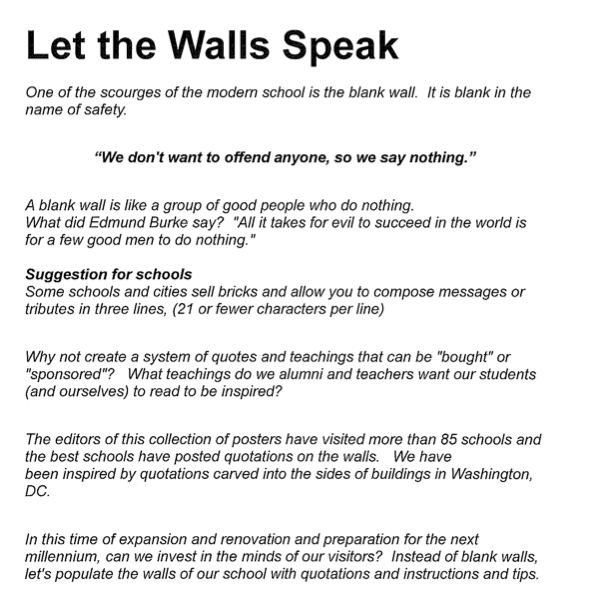
    We can transform our schools and our classrooms with posters

    https://sites.google.com/site/posterstransform/books

    Start here with books


    Here's a review of the MENTOR book:

    We know that MENTORS are helpful for teenagers. How about an easy way to bring adults into the leanring community -- virtually? Telephone email blogs Facebook It's up to our imaginations Adults can bring the world into schools.

    • Paperback: 94 pages
    • Publisher: CreateSpace Independent Publishing Platform; 1 edition (May 24, 2013)
    • Language: English
    • ISBN-10: 1484816285
    • ISBN-13: 978-1484816288
    • Product Dimensions: 9 x 6 x 0.2 inches


    Visit the Amazon site


    Then move to Posters


    You can transform your classroom and your school's environment


    Sunday, November 3, 2013

    Seen in New Zealand -- a poster with a mesage

    How can this poster pass the Two-Factor test developed by Richard Clark?  What procedure will we use to put this poster into action?


    This poster was seen in New Zealand.

    Photo by JK McCrea


    Thursday, June 6, 2013

    Where do posters come from? This poster came from one of my colleagues, who recommends Ken Bain's book about Great College Teachers

    "I watched the dancing quotations video and really enjoyed it."

    Ken Bain's Whatthe Best College Teachers Do has inspired one of my colleagues to send me the following note and quote from his book:


    I watched the dancing quotations video and really enjoyed it. One of the quotes reminded me of a phrase from Ken Bain's What the Best College Teachers Do (an amazing book--it will rekindle your love of teaching if you're ever down). This isn't an exact quote, but it's close: "A grade is the beginning of a dialogue between the student and I as we explore how well the student has understood the material." And then, I couldn't stand not having it right, so I went looking for it. Here's the paragraph:

    ...the syllabus summarized how the instructor and the students would understand the nature and progress of the learning. This was far more than an exposition of grading policies; it was the beginning of a dialogue in which both students and instructors explored how they would understand learning, so they could both make adjustments as they went and evaluate the nature of the learning by the end of the term.
     
    Great stuff. 


    Link to the video  youtube.com/KpHagen1

    By the way, KPHagen.com has an excellent video about how professors can work together to accelerate feedback to students


    Here's one of the links to the dancing words.