Showing posts with label elliot washor. Show all posts

Friday, October 18, 2013

Finding Mentors for my students: the highest work for a teacher (in the Littky/Washor Big Picture system)

One of the best things a teacher can do is to link a student to a mentor.

Here's what I wrote to a guy named Chris -- I heard him talk at a cafe and I just had to ask him to consider being a virtual mentor for some of my students...

======

MY EMAIL to Chris
====

Chris

Here's what I remember you said to your friend.

"God has a perfect body waiting for you."

What other words could be said to a person who is preparing to leave?  I could teach a class of 30 kids for a year and not one of them might come up with a better sentence.   

Your story could inspire others to "do what Betty did"  (I think you said her name was betty).
What did Betty do?  For 33 years she devoted herself to helping others.

A lovely statement, but why not tell three or four stories about "what betty did" and post them on a website.  Then I can point my students to read your stories about betty and maybe some of them will be inspired to "do what betty did" (help others) 


Thanks for your time.   I am between teaching jobs at the moment and the best use of my time is to hang out at coffee shops (not the chains) to look for people lie you who speak passionately, eloquently and with verve.  I want my students to be influenced by people like you.


I teach English as a second language during the summer to collect teens who want to improve their English (from Europe and S America) and then when I 'm in classes in a typical school., I try to inspire my U.S. students to reach out and assist the International students with their accents and to improve their conversation skills in English.

in other words, it's community service via facebook, skype, Instagram, twitter and email.  (things that many students like to do anyway)


Your story about Betty has inspired me and I will share it with my facebook friends and with my U.S. students (some of them are prepping for the SAT).  I also have a good friend who is a guidance counselor at a charter school and he will look for artistic minded kids who want to learn about "the real world"...  

Again, please write two or three stories about what Betty did specifically and that might inspire some of my U.S. students to begin reaching out to my international students. (I have a list at bibpenpals.com that shows their email addresses of international student who are waiting for conversation practice with U.S. teenagers)

Best wishes,

Steve

Here are some links about the need for graphic concepts in education.


a)  Dan Pink    the MFA  > MBA
  1. Is An MFA The New MBA? | Fast Company | Business + Innovation

    www.fastcompany.com › Fast Company › leadership
    Mar 28, 2013 - In fact, according to an annual survey tracking the career trajectories ofmore than 65,000 artists from hundreds of arts schools, the Strategic  ...
  2. Daniel Pink and the Economic Model of Creativity - Washington Post

    articles.washingtonpost.com › Collections › Brain
    Apr 2, 2008 - Or as Pink puts it in a classic bullet point: The MFA is the new MBA. ...More bullet points, delivered as Pink wandered the stage with a microphone headset ...World's Best Lasagna tops AllRecipes list for more than a decade  ...
    You've visited this page 2 times. Last visit: 8/12/13
  3. The New MBA - Visual and Active - Google Sites

    sites.google.com/site/visualandactive/Home/about-us/.../the-new-mba
    (Daniel H. Pink is contributing editor at Wired Magazine, American's leading writer and.... from Ringling more valuable than you ever imagined when you enrolled ... corporate positions, the rules have changed: the MFA is the new MBA. In.
b)  connected principals

c)  The Vimeo channel for a remarkable director of documentaries
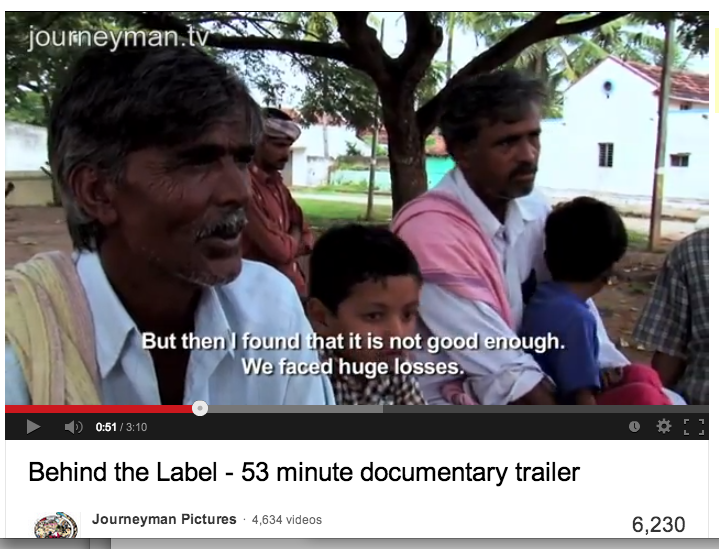

Here is the trailer for his Genetic Modified Indian Cotton movie called "behind the label."  Please click to increase hits.
  1. Behind the label - Trailer HD on Vimeo
    http://www.youtube.com/watch?v=sN6dGq3m4rY

    vimeo.com/23493184

  2. May 9, 2011
    Behind the label A documentary by Cecilia Mastrantonio and Sebastiano Tecchio... I went to this link youtube.com/watch?v=sN6dGq3m4rY and there is a link to buy ... Seba Tecchio'stechnique has grown in complexity, adding layers of ... behind. label. cotton. GMO. GM. organic. OGM. documentary. india.

Let me know if it's okay to send your email address to selected students.  I'll ask them to keep their questions short and no more than one email message per month.


Steve Math Teacher
Steve McCrea
Editor, Building More-Responsive Schools by Abraham S. Fischler, Ed.D.  

I am a Test Prep teacher at Broward College (Continuing Education Department):  I teach the 12 Global Skills through the ARTS focus (and my students think like mathematicians and musicians)
I embrace the "musician's approach to academics":  practice, practice, practice until we achieve mastery.

Please give hits to these websites   
Schools that I admire   MetCenter.org    BigPicture.org    L1to1.org   essentialschools.org
chadphila.org      
www.MiamiArtsCharter.net and to my youtube channels


Math Teacher\
Mobile  +1 954 646 8246

1477504   ASCD Member since 2005.
I recommend membership in ASCD.org, the pubisher of Littky's important book
The Big Picture (2004).

Why not visit the web book?   www.Transform-Education.com  http://rcptv.com/te/

Visit the Travel Blog     RoadloversInternational.com


"People think focus means saying yes to the thing you've got to focus on. But that's not what it means at all. It means saying no to the hundred other good ideas that there are. You have to pick carefully. I'm actually as proud of the things we haven't done as the things I have done. Innovation is saying no to 1,000 things." (Apple Worldwide Developers' Conference, 1997)


Please visit this video and raise its hits.
310 views on 10 May 2013
4 likes
please suggest a video that we can click

KATIE GIMBAR's  list of 16 videos about Flipping the Classroom.  let's celebrate her success


as an SAT test prep teacher, i like engaging the help of parents, so here are some hints
www.FreeVocabulary.com
www.MajorTests.com

I mentioned Dan Pink:  "Motivation 3.0" is a way of giving advice and sharing
Dan Pink talks about the new economy.


some of my blog posts

From Pablo

From Dennis Yuzenas

About Charles Cornelius  

Three-Minute training

John Corlette (I met him in 1972)

LIFE SKILLS
Not one person is expecting anything from you in the next 4 hours. So the ability to appreciate the task at hand and thinking creatively seemed natural.
A FUN SURPRISE: DISCOVERING YOUR DEPRIVATION
What I was depriving myself from was time in the day where there was no pressure and no expectations. For the same reasons that I felt most creative on Saturday mornings and on planes, 4 a.m. has become a place of productive peace. That feeling is why I love what I do. I don't need a vacation. I don't need to step away. I just need a couple hours a day before anyone else is up.

Making an omelette, coffee, playing guitar, exercising, listening to the Dan Patrick Show, learning a language, and getting some exercise all felt like optimal experiences when not in completion for mental bandwidth slated for the company. And by 6:45, I'm working on the biggest items on my plate that I can focus on without the threat of new stimuli for the next couple of hours.

Building a schedule that protects your love for what you do is critical to optimizing the quality of your life--and your work.
Paul DeJoe, FastCompany article


I have been following D.r Amen's recommendations about the use of email for several years.

1.  I look at email only once or twice a day
2. I stay focused.  Before looking at my email, I write the priorities of my day.  
3. Then I look only for email that are related to my priorities of the day.
4.  I don't worry about responding to each piece of email.  Set aside a day once a week to deal with every other message that you receive.  
5.  I tell my new clients to send me a text if they want me to look at an email within 24 hours.     Generally it takes 72 hours for me to look at every email message.


954 646 8246 is my phone


=====

ABOUT CHRIS

I hope he will write about Betty.  I can imagine some of the nice things that Betty did.   

If you are a teacher or a student and you want to get in touch with Chris, write him a letter send me the message.... and I'll pass on your email address and message to him.

Saturday, July 6, 2013

Thoughts about "Better Schools. Fewer Rules" (The Steve Roberts Campaign in Kansas)

Better Schools
Fewer Rules
The campaign by Steve Roberts...
 robertsforeducation.com
If you are looking for better schools, start with MetCenter.org  and the books that have emerged from

that organization, such as The Big Picture:  Education is Everyone's Business by Dennis Littky and Samantha Grabelle... and Leaving to Learn by Elliot Washor and Charles Mojkowski.  Click here to get some sample chapters and to see the LEAVING TO LEARN website  LeavingToLearn.org


(1) Big Picture Schools have fewer rules

www.BigPicture.org


Click here to get the video
(2) Mealtime Meetings About History
David McCullough suggests that we need to talk about history at dinner.  "We are raising children today who are historically illiterate."
http://www.youtube.com/watch?v=FjU1BxANfsI
Noel Thompson, an entrepreneur in Warwick, NY, has added, "Perhaps grandparents will save the day for us.  They have the perspective and perhaps they can be interviewed by teenagers.  The grandparents can point out how things have changed."


look at the button on the right of this screenshot
How do you download a video from Youtube?  (how do you bring a video into a classroom that doesn't have a strong connection to the Internet?)  I use KeepVid.com.

It allows you to put a button on the top bar of the search engine, such as Chrome, and I just click the button when I'm looking at a youtube video that I want to download.

The menu gives me some choices and I like to select .mp4.

Here's the choice menu.  


Go ahead, download the button for KeepVid.com


Steve Roberts can't vote for Intelligent Design...


Monday, May 6, 2013

What's your philosophy of education? I got it down to four points.

This post is dedicated to two of my favorite administrators of language schools, Tony and Leslie.  They have inspired the best in me.


Principles that I try to use in classes
a) find out what each student wants to learn
b) have an overall plan for the class
c) but serve each student when possible
d) make sure every student speaks often

Search "cnn student news"
=============  


in an English language class
find out what the students want to learn
deliver it
create a culture of learning and self-pushing
make each day a possible 

I'm re-reading Mary Finocchiaro and i like her list of twelve
a) to know intimately
the students
 and the
community in which
they live
"should"s or principles from 

I particularly like the first principle.

a) to know intimately the students and the community in which they live in order to relate new language and cultural materials to probable experiences and interests of the students.

other points... (highlights, excerpts)
b) to broaden students' experiences through discussion of music, art, hobbies and other areas of interest in the school curriculum or in the community.
c) to enrich the students' vocabulary
d) to teach as quickly as feasible the formulas of English
e) to present all new vocabulary in easily demonstrable situations
f) to exploit every language learning activity so that it will reinforce and facilitate communication
g) to proceed from tightly controlled drill to freer, more authentic creative expression from the very first day of the language program.
h) to reintroduce structures and vocabulary of high frequency as often as possible
i) to add authentic, meaningful language activities and sort, two or three line dialogues for frequent dramatization.
j) to suggest or encourage students to suggest alternative sentence sin the dialogue utterances so that they will not always expect the responses they will have learned in the original dialogue.
k) to modify the sequences and order of materials in textbooks so that questions o all kinds and the pronouns I and you are introduced and practiced very early.
l) to remember that understanding the meaning of any utterance depends on knowing its single elements of pronunciation, of grammar, of vocabulary and of culture.
Finocchiaro, pages 74-76, recommended by Mario Llorente

I post this list on the wall so students can say, "Hey, Steve, you didn't do numbers h and j today."

How does this approach translate into a class?  What procedures do I use?  What stages are set in the class?  

1.  There's a plan, a grammar point, some dialogue, pronunciation practice, an interesting reading point and something to listen to from CNN perhaps   


2. i like the studentnews transcript that is available each week

I found it easily by typing a search without spaces  "cnnstudentnews"

3. My job is to present materials for learning and then adjust to each student's needs and requests.  I'm a concierge.

4. I arrange time to meet with each person and get their goals on paper in the first day.

Other points of interest and inspiration (see part 2)

Sunday, May 5, 2013

Three photos that turned me into a virtual mentor. I visited the school twice and now I'm continuing to remain in touch... and you can become a virtual mentor, too.

Thank you, Dr. Amen:  The ANTs or
PENAs in Spanish (invented by Mario
Llorente, translator)


Please take a moment to look at these photos.

This is what happened when I started listening to Enrique Gonzalez.  I stated thinking, "How can I personalize my lessons?  How can my student's work come out?"

Dennis Littky wrote that most people ask, "What are you going to teach our students?  What is your expertise?"
but really teachers do their best work when they bring out what is inside the students.


This is based on my SAT Test Prep work
(That's a quote from The Big Picture:  Education is Everyone's Business, 2004, by ASCD.org)

That's what these photos show.  I came to the campus of Highland Park high Scholl and I simply shared with them some ideas.

The students did this work.


See the 7 Survival Skills by Tony Wagner

This is what any adult can do.   Adopt a class, sit with some students, talk for a short time and then listen.

The best part of being a mentor is saying, "Oh, you want to make a yearbook?  Here's a simple and inexpensive way to make your yearbook.  Have you thought about using CreateSpace?  $10 plus $2 shipping and the book will have color photos."
Go ahead, order the book

Then I just sit back and wait for their questions and see what they produce.  

Becoming a virtual mentor means doing everything a school volunteer does but at distance and without the commuting time of driving to the school.


"Our principal is a man... unlike in other schools, there's just a suit..." a video by Erik Friedl about a school in Los Angeles (Highland Park High School), which benefits from the philosophy of Elliot Washor and Charles Mojkowski

http://www.youtube.com/watch?v=A34AR57A1Eo


Look at Minute 3:20
"our principal is a man... unlike other schools...

 it's just some suit with a face

Our principal has a personality.

he gets through to us.


Well done to Erik Friedl for capturing this moment.   Visit his channel at Youtube.com/aiglon27

Click here to see the hits rise.   576 hits on 5 May 2013


You can learn more about some of the people whom Enrique acknowledges (around Minute 5:30 in the video) by searching for these links on Youtube.


Elliot Washor  http://www.youtube.com/watch?v=QoopqI7nPfo
Add a few hits at THIS LINK

author with Charles Mojkowski of Leaving to Learn

look for the website   www.leavingtolearn.org/


Learn more through an interview with Steve Harganon


Hear the mp3
Elliot talks about "paying attention" to the student.  Start at minute 16:30 and hear his point about the school needs to pay attention to the student.

Sunday, February 24, 2013

How to improve schools: Talk to teachers in graduate programs about "Leaving to Learn" by Washor and Mojkowski


I have been talking with principals and teachers for several years about the importance of the Big Picture learning system.
Get the book on Amazon.
The new book by Washor and Mojkowski gives an opportunity for graduate students to be part of the transformation of schools.  I am lucky to know several teachers who are in master's degree programs and one of them asked me to suggest some books and articles to include in a research paper.  Fortunately, Enrique Gonzalez had recently told me about the Washor and Mojkowski book, Leaving to Learn, and so my friend, the graduate student, might be one of the first people to write about the recommendations in this book.

To improve schools, let's remember to contact tomorrow's teachers today.


Thursday, February 14, 2013

Elliot Washor and Charles Mojkowski describe the new normal in Leaving to Learn (review) -- This book is a report from 2040.

Perhaps someone will read this review 27 years from now and smile:  "Yes, Leaving to Learn is normal in 2040."

Here's the link to the book.

This book has vital material for teachers and principals in the fight for resources to deliver good programs to kids:  The key is to make school personal for students.  Build the programs around each student's interests.

From the "inside look" on Amazon


Yes, this is copyrighted material...  and the publisher will be glad that I shared it with you.


========== 

"Researchers have calculated the cost to society of dropouts but have missed the significantly larger cost of disengaged students who graduate from high school but are nonetheless unprepared for lifelong learning and whose talents and potential have been sadly ignored, often because those talents lie outside the traditional subject matter focus of a cognitive/abstract curriculum."
P. 120


Dennis Littky said the following in an interview in 2005 with National Public Radio

 I think my frustration with the world is that in many suburban districts where parents move to send their kids and the students come home with their As and Bs, the parents are satisfied, but they never look deeper, so they think those are good schools. They have the highest SAT scores, they have the most kids going to Ivy League colleges. 

Those kids are losing too. They are not dropping out because they are playing the game. When you ask them, "Have you made any decisions in school? Do you care about anything, are you passionate about anything that goes on during the day besides drama club or football after school?" They're getting the short end. They aren't allowed to get engaged with their work and go deeper. 

"My kid did well at that school." Yeah, but where could your kid really go if your kid got to work with a doctor in 9th grade, following her around, and really going in depth? 


https://sites.google.com/site/visualandactive/Home/about-us/thats-edu-tainment/readings/littky-on-npr

Elliot Washor and Charles Mojkowski have written the book that could aid those principals who are waiting for the right vocabulary to hit their desks.  This book is the sledgehammer that principals need to tear down walls separating the workplace from classrooms.  This book is the scissors needed to cut through red tape.

Parents can use this book to get the personalized school that will serve their children.

SUMMARY:  Leaving to Learn...
Great title.  

Excellent procedures (pages 108-116 plus policies 123-124)
Vocabulary for teachers and principals... just the right amount of documentation to persuade a superintendent to allow a change in procedures....

Hey, parents and students, 
School can be fun again -- and worth your time.  Find out how:  step one:  Photocopy pages 108-116 and pages 123-124.
step two:  deliver those copies to your principal.
step three:  get a petition started to support these programs.
step four:  deliver the signed petition to your principal's bosses.
=================  

The morning after flipping through Leaving to Learn, I saw this piece of good news:

Students at University of Miami are making ads in classes to help non-profit organizations.

but wait...  why is there an article about that?  What is so special about this program?  From the perspective of a person living in 2040, this is what all schools offer...

Here's the comment I left on the newspaper's website:
======


Thanks to www.WhatDoYaKnow.com (Dennis Yuzenas website)

Thanks to Frida Kahlo, the New Learning Institute and the work that Enrique Gonzalez showed me


… this type of active student work is normal.  

McCrea at 7:38 AM February 14, 2013
I applaud the editor of the newspaper for running this article...    let's also be aware that there is something amiss in our educational system and our low expectations for schools where this article is "news."  
why is this situation such a big deal?
Why is this situation not as common place as a classroom equipped with a whiteboard with dry erase markers?
Shouldn't "students making ads" be as normal as "students use powerpoint to present information in class."?
why is this worth an article in a newspaper?
Aren't students doing this kind of thing anyway?
I feel like we're stuck in the 1980s, that nobody has heard of computers for personal use.  why is this article in the newspaper?
it should not be news, it should be normal.
   well, here's a toast to innovation in universities and here's a hope that high school and middle school teachers and principals are watching.  Dennis Yuzenas has been doing this sort of thing since 1990   see  www.WhatDoYaKnow.com 

========  

In short, Washor and Mojkowski have compiled a 150-page book that describes problems with schools and offers easy-to-follow procedures for allowing kids to learn outside the classroom.

The book will help parents talk to principals, who might have heard of projects and digital portfolios and personal learning plans, but lacked an easy-to-read way of showing their teachers "Hey, let's do this."   

As a convert to the BigPicture mindset, I thank the authors for this book.  Elliot and Charles are expanding my vocabulary and making me more perplexed -- Isn't this what we should be doing now?  It's been nine years since Littky's book came out... Why does it take so long for the obvious to get into practice?

If you have read The Big Picture, you will know the "personalized" mindset (and imperative to "build the school around the student") and you can jump directly to the "Supporting Leaving to Learn" pages 108-116:   There's no need to reinvent the wheel or reverse engineer the procedures (teasing procedures out of the stories that are told in The Big Picture).  It's clear what we teachers, principals and parents should be doing.  

So I end this review with a wink to 2040:  About 5% of us are already living in the future.    We're with you, 2040.  We're ready to work with others to join us in the future.   

TWITTER SUMMARY
Leaving to Learn
Working outside the class is the new normal and anything less is just boring, lazy or uninformed.   Elliot Washor and Charles Mojkowski have shown us that we can make school fun again.


If you haven't read The Big Picture, you can read Leaving to Learn and find out what to do.   


The procedures in LEAVING TO LEARN will open doors in ways that prepping for a standardized test will not.
"Hey, students!  Bored with high school?  Here's the hack --  take pages 108 to 116 to your principal and ask how you can leave to learn."

 Thank you, Elliot Washor and Charles Mojkowski, for the fast read:  Let's work on translations (Spanish first, then Turkish, Italian, Arabic and Romanian).