Learn about readings by Neil Postman, Lois Hetland, Howard Gardner, Dennis Yuzenas, Abe Fischler, Dan Pink, Thomas Friedman, John Corlette, Will Sutherland, Tom vander Ark, Marshall Thurber and other innovative educators.
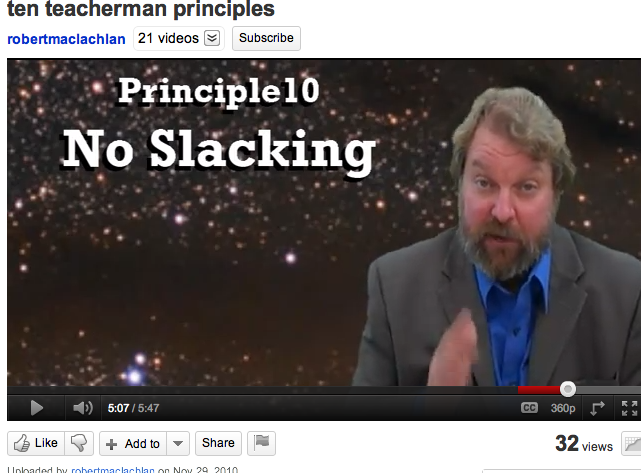
Learn the ten principles of effective use of media in the classroom (and in online classes).
Key quote: "No slacking -- don't lean on technology and skimp on preparation."
I agree. Have a backup plan, an email link in case the embedded video doesn't work, all the media on a DVD if there's no power in the classroom, on a flash drive (USB flash) to pass around to laptops. Can you give the lesson outside under a tree?
I found Robert MacLachman's youtube channel while completing at course in Nova Southeastern University's Distance Education program. Let's give Robert the exposure he deserves. 32 hits up to 27 July ... Let's get him to 1,000 before his video is one year old.
His channel youtube.com/robertmaclachlan has other videos, some with fewer than 100 hits. Distort the net and join me in "liking" this guy's work.
We are all impacted by the quality of our nation's schools. Public education has economic, social, and moral implications for our country. That is why this movement is so important, and we are so grateful you're involved. I have been so fortunate to speak with many StudentsFirst members in person. Many of you want to know more about the mission of StudentsFirst, while others have had some really interesting questions about education policy and what reform means for our kids.
Unfortunately, I can't visit every hometown and sit down with each of you, so the StudentsFirst Team came up with a fun idea called "Ask Michelle."Submit your questions online now and I will respond by video.
America is having a national conversation about education reform. Discussion about how to improve our schools is pervasive -- on the evening news, in the teacher's lounge or during a neighborhood gathering. Sometimes these conversations leave people with more questions than answers.
I will respond to your questions openly and honestly with my perspective as an education reformer, a former teacher, and first and foremost a parent. The issues our country faces are complicated, difficult, and deserve serious answers.
I welcome your questions on anything -- from teacher tenure and teacher evaluations, to "last in, last out" (LIFO) policy and StudentsFirst's Save Great Teachers campaign. The sky's the limit.
Dennis Littky said the following in an interview on National Public Radio in April 2005: "The commissioner of education (in Rhode Island) Peter McWalter said to me, "I could have closed this school down the first year, but I had the patience to watch and I've never seen people who had the belief in the maturity of the kid" -- so half of our great work is because the [kids] grew up. In most schools, they don't get to [grow up] -- they get stopped before [they can prove themselves]."
In the Littky success story, part of the credit for success goes to Peter McWalters for giving Littky's staff the time to meet goals and to create a school with different procedures.
You can get the full radio interview at npr.org and search "Dennis Littky Small school"
Littky's school is a charter and from what I've seen in Florida, charters are generally inspected by the school district. To pass inspection, many charter schools adopt the same curriculum and general rules and penalties for discipline that traditional schools use. (In Broward County, where I work, this means a 30-page code of behavior that the students have to agree to follow - who reads all that?)...
What do you recommend? Should we teachers and parents go to the legislature and get the charter schools permission to try a different curriculum and discipline structure? Under the current scheme, most charters eventually look a lot like the public schools that the kids couldn't perform well in... so why should we be surprised when many kids fail to get engaged in our charter schools?
Bottom line: would removing school district oversight help charter schools find "a different way" to differentiate lessons and personalize the instruction, allowing more project-based learning?
Wolfram on Thursday rolled out its Computable Document Format (CDF), which aims to turn documents into interactive applications.
The goal is to turn “lifeless documents” into ones that bring data to life, show the data behind assumptions and illustrate concepts. Conrad Wolfram, strategic director of Wolfram, said the CDF effort has now reached the point where the company can open it up to developers, publishers and other interested parties.
Wolfram is still working out the business model behind CDF, but publishers have shown “great interest.” For now, CDF is delivered via a free player that can bring infographics, journals and math lessons to life. It’s not a stretch to see how a magazine like Popular Science could publish in the CDF format.
The rub is that Wolfram needs adoption and there’s already a dominant document format in Adobe’s PDF. One big challenge would be figuring out the interplay between CDF and PDF. Would someone want to embed a CDF document into a PDF. Conrad Wolfram said that “the CDF format will be open” with the goal of becoming a public standard.
In a demonstration, Wolfram highlighted a bevy of use cases. Financial documents such as 401K information could highlight the assumptions behind savings models. If global warming papers could have detailed the underlying data in the models perhaps there wouldn’t have been climate gate, noted Wolfram.
For now, Wolfram needs developers on board. CDF has reached the point where a developer with the knowhow to author an XML document can bring publications to life. Indeed, the use cases for CDF revolve around:
Suppose a person creates a book with plenty of versions:
a) lots of photos, color for scrolling online or in a PDF
b) lots of photos, grey for black and white printout
c) very few photos, mostly to reduce printing costs, with plenty of references
d) ready to photocopy with large formats for posting around the classroom.
Basically the same material but the formatting is different for the different uses. That's what Lulu.com allows since there is NOT a heavy cost for the first copy of the book. In some print-on-demand books, you get ONE chance to get the format correct, so it is very difficult to innovate as you create. But with Lulu.com, I can create a version that is pocket sized, then another with LARGE format pages ready to be photocopied. Same quotes, different size of type. One content, two or four different formats. Let me know your thoughts. HappyMathTeacher@gmail.com
Thanks to John Vornle for passing this post to me.
To make it easier for readers to look at this article, I've reproduced it here. Please click on the link to take you through to the article (and whatever hits might then be produced). I'm posting the material here in case the link is corrupted. The data in this article is perplexing and I invite you to comment on it.
I have tried to imagine implementing this study's findings in my class. What is the downside of getting a stronger memory? REVULSION. Why would I want to bring negative images of dead animals into my class? Less mature students are surely going to disucss the ugly photos and some might react by running away from the photo. how could that enhance the new connection to
This is a study that I will use cautiously. I prefer to surround my students with positive influences. WE TEND TO MOVE toward the things we think about.
A well-established finding in psychology is that successfully retrieving information from memory serves to consolidate the storage of that information. Each time your brain's filing clerk tracks down the right information, the more likely he is to find it another time. Psychologists call this the testing effect - practising retrieval of information is far more effective than simply re-studying that same material.
Can this benefit of testing be enhanced? Yes it can. A new study has provided the first ever demonstration of how to enhance the memory consolidation that occurs after correctly answering a test question. Bridgid Finn and Henry Roediger's important and somewhat surprising new finding is that following a correct answer with an aversive stimulus serves to enhance the consolidation of that memory. It's like punishing the filing clerk after each correct retrieval makes him even more accurate in the future.
Forty undergrads studied multiple lists of ten word-pairs, each featuring a Swahili word and its English translation. After each list of ten, they were tested. Presented with the Swahili, they had to answer with the English. Here's the important bit. If they answered correctly, one of three things happened immediately: a blank screen appeared, a neutral picture appeared (e.g. a fork) or a negative, aversive picture appeared (e.g. a dead cat).
After this pattern of study period and test had been followed for ten lists of ten word-pairs, the participants were then given a jumbo test of all 100 Swahili words. Here's the key result: for those items answered correctly in the earlier mini-tests, it was those that were followed by a nasty picture that were most likely to be accurately recalled in the final jumbo test. Earlier correct answers that had been followed by a neutral pic or blank screen were not so well remembered (and performance was equivalent across the blank/neutral conditions).
"These data are the first to show that arousal following successful retrieval of information enhances later recall of that information," the researchers said.
A follow-up study was similar to the first but this time correct answers in the initial mini-tests were followed by neutral or aversive pictures that appeared two seconds later, as opposed to appearing immediately as they did in the first study. This was to see if there was a narrow window beyond which a negative stimulus wouldn't any longer enhance the consolidating effect of correct retrieval. The results were just the same as for the first study, so even two seconds later, a nasty picture is still able to enhance the memory consolidating effect of a correct retrieval. Future studies are needed to test just how long after a correct retrieval this process is still effective, and to see if positive images exert a similar benefit.
Finally, the researchers looked to see if the presentation of a negative pic has its memory enhancing effect after items are merely re-studied, as opposed to recalled. A similar protocol with Swahili-English word pairs was followed as before, but this time, instead of mini-tests after each set of ten word pairs, the participants were simply given the pairs to study again, with each pair proceeded either by a blank screen, neutral picture or nasty picture. This time, there was no benefit of the negative pics. In fact, there was a trend for pairs to be recalled less often if they'd been followed by a nasty pic in the earlier study phase.
Why should negative images boost the consolidating effects of answering a test item correctly? Finn and Roediger aren't sure but think it has to do with links between the amygdala, which is involved in fear learning, and the hippocampus - a brain area involved in long-term memory storage. This is a rather vague account and doesn't explain why aversive stimuli only enhance memory after correct retrieval, not further study. By way of further context, a 2006 study showed the presentation of aversive images after to-be-learned stimuli was beneficial during the initial study of that material.
Post-script
I couldn't help wondering what Milgram would have made of this study. Recall that participants in his classic obedience research thought they were taking part in an investigation of the effects of punishment on learning. In Milgram's mock set-up, the "learner" was subjected to an electric shock each time they answered incorrectly. Of course, Milgram wasn't really studying memory, but this new article suggests that he could have been onto something. Somewhat paradoxically, though, it seems it's correctly answered items that ought to be followed by an aversive stimulus, not incorrect answers. _________________________________
Finn, B., and Roediger, H. (2011). Enhancing Retention Through Reconsolidation: Negative Emotional Arousal Following Retrieval Enhances Later Recall. Psychological Science, 22 (6), 781-786 DOI: 10.1177/0956797611407932
JOHN's COMMENT: .... he retrieved this article using an iPad.
I'm not convinced by the manner in which this apple technology forces me to communicate with others. I can sense how it completely dominates the communication of inexperienced youth. In my opinion, it does not allow for the reflection necessary for a worthwhile communication. In my world, the individuals with whom I work, they don't have time for the luxury of wasting other people's time. It reduces the value of each communication.
The brain doesn't know the difference between something vividly imagined and the actual experience.
Dr. Joe Pace, The Pacific Institute
(954) 926-5668 drjpace@msn.com
We tend to move toward whatever we think about.
The foundation of all human action is human thought.
We rewire the brain by thinking about something over and over.
We change the wiring by replacing pictures and replaying those new mental images over and over.
Schools should have a cap and gown and a sample diploma in a special room. Every student can imagine putting on the gown and receiving that diploma -- and then a photo is taken. What do I look like in that moment? What do I feel in that moment? What does it feel like to be a graduate? The photo goes home and the student looks at the photo again and again.
You can't direct the wind, but you can adjust the sails.
from a presenation at Summer Conference organized by Nova.edu
Random Learning I returned a rental car during lunch on Wednesday during a conference. I rode back with Mr. Hidalgo who was listening to Dennis Prager on the radio and we got to talking.
"I tell my son, 'Be comfortable with the uncomfortable.' When he asks me to buy something for him," Mr. Hidalgo said, "I ask him to negotiate and find out about the warranty. He has to be ready to move forward by himself."
AN INTERESTING INTERNSHIP "I tell my son to watch Hard Core Pawn. Anyone who watches that TV show for at least ten episodes will become better at business. If a young person could work there for a month, he would be set for life. I don't know why any teenager stands on a corner with a sign, waving it around. What does he learn doing that? It would be better to work in a store like Hard Core Pawn and really learn about how to run a business."
Two of his children are college graduates or in college, one at Columbia, and his third child (age 14) is in ninth grade. "I already took him to visit his brother at Columbia. I want him to think that this is part of his future." That's an engaged parent.
I'm at a conference to learn how to become a better teacher, how to find better learning materials and how to motivate students. I got my best tip from the guy who drives a shuttle bus. Bravo, Mr. Hidalgo.
Some people in the United Kingdom are looking closely at charter schools in the USA. I got wind of their interest in importing the charter structure to Britain and I composed the following open letter:
To anyone interested in opening a charter school:
if you go to 1 minute 20 (1:20), you will see the transcription.
The commissioner of education (in Rhode Island) Peter McWalter said to me, "I could have closed this school down the first year, but I had the patience to watch and I've never seen people who had the belief in the maturity of the kid" -- so half of our great work is because the [kids] grew up. In most schools, they don't get to [grow up] -- they get stopped before [they can prove themselves].
In their blogs they both write about the power of the correct approach in the use of the charter school format.
Too many charter schools simply copy a school structure and teaching methods that "worked" 40 years ago. The charter schools that produce long-lasting results (students who have mastered the seven essential skills that Tony Wagner writes about in the Global Achievement Gap) use relationships and projects in their instruction.
Perhaps the most instructive thirty seconds about "how to create effective charter schools" comes from an interview with Dennis Littky of Providence, Rhode Island. (see the link at the start of this letter)
Note the later part of the interview with Littky:
Critics laughed when they saw we had internships. Then they saw that we had the highest attendance rate in the state. We had the lowest drop-out rate in the state. But they really became believers when they see that every kid got accepted to college. Five years later they're still in college or graduated.
... We keep pushing ahead and trying to show that this is a way to help kids get educated.
We outscored the three largest high schools in mathematics and we don't teach a mathematics course. The kids learn to think like mathematicians, to solve problems and use their minds. The scores are not great, but they are moving up. Colleges are impressed with how articulate and passionate our kids are.
The point is that the test scores were not the result that Littky looked for ... it was what happened to the students.
1) the highest attendance rate in the state.
2) the lowest drop-out rate in the state.
3) every kid got accepted to college. 4) we don't teach a mathematics course. 5) colleges are impressed with how articulate and passionate our kids are.
Peter McWalter's remark is key: The project-based, student-centered charter school with a focus on relationships needs time and delivers results in ways that a standardized test does not reveal.
I hope this information assists you in identifying the positive aspects of charter schools in the USA. There is much that discourages me in the charter school movement in the USA, but there is good work happening at hightechhigh.org and at Littky's BigPicture.org schools.
I am a taxpayer and I believe that teachers, students, principals and parents need descriptions of a new way of teaching. I wake up every morning with Dr. Fischler's question in my head: "How do you become a visible change agent in this environment?" and "Time is a variable" and "The Student is the Class." The words of Daniel H. Pink, Will Sutherland, John Corlette, Eliot Levine, Elliot Washor, Charles Mojkowski and Dennis Littky inform my daily work.

 Please click on this link


