Tuesday, April 24, 2012

Remember this classic book: Have you been "Driven to Distraction" lately?

The name of this blog comes from this insightful book.  ADD people are curious, often constantly.   It might have been a very useful trait among certain groups, but gradually bureaucracies come to see the ADD hyperactivity as disrupting.


Go ahead, order an extra copy.   Look at the chapter where the discussion goes to "why is ADD so often found in the USA and not in Europe?"  Simple:  we who are "chronically curious" got on ships and didn't return.  We took our "different" genes and brain wiring with us.


Even teachers ought to know about the parking Paul


What did Ringo, George and John know about PAWL?
How many times have you used your car's parking brake this year?  Two or three times?  
The answer should be: at least twice a day.  Come to a stop, with your right foot on the break and the car in drive, press the emergency brake so it holds the car, slide the shift into PARK, and pull your right foot off the brake.  Ahh.  Now the PAWL has no pressure.  The parking pawl locks the wheels and stops them from turning.  By using the emergency brake, you reduce the "wear and tear" on the parking pawl.  As columnist Jonathan Welsh writes, "Even the slightest incline puts pressure on the pawl."  (WSJ.com)   Get the news directly

The photo comes from my buddy Mario's view of a fabulous rooftop in his favorite capital city.  This place has little need for pawls because so few people own cars. But I intend to use the pawl if I ever get a car there.


Why does technology stay unused in classrooms?

Here' the summary...


An interesting approach.

To watch the video, I had to complete a survey.   Hmmmm.


Nice looking survey and not too long to fill it out...


I'm impressed.


At some point I want to learn how to link a survey to a youtube video so that I can teach my students.

What software is used to collect the contact data?

Where does the data get stored?

In what format?

How do I send email updates to the people who have entered this information?

That's the real-world info that needs to be given to kids so that they can make videos and then contact people who see the videos.

Monday, April 23, 2012

Why I invite students to link to my Facebook account

Let's be clear.  I do not actively seek out my students on Facebook.

I don't ask for their email addresses and then ask them to be my "friend."

However, I make it clear that I will answer questions by email, text to my mobile phone, through my blog and on Facebook, Orkut, tuenti, sonico, vKontakte and hyves.net.  I encourage them to write to me on Facebook so that I can recommend BIBPenpals.  See www.BIBPenpals.com and www.Youtube.com/bibPenpals.

Why?
a)  Gordon Dyke, Tony Hyde, DB, Clive Hartwell, Will Sutherland, David Rhodes, Teddy Senn, Mr. Koch, and others.  I went to a remarkable boarding school where the faculty lived on campus and took us on expeditions in the mountains on weekends and ate dinner with us to reinforce the finer points of civilization.  20 years later I realized where I got some of my notions about what a "good teacher" does and I wanted to thank Gordon, Tony, Clive, DB, and others... and I could because the school kept in contact with those teachers.   The benefit of the contact was more for me and my need to express my gratitude than for them to actually hear it.   It was more to benefit me --- I felt that I had slightly moved to balance the scales by saying, "You made a difference when I was a self-centered, ego-driven kid."


b)  My wife's favorite teacher:  He was a passionate fan of the U.S. Civil war history and filled his students ears with details about the war so that my wife was well prepared to say, "Everyone knows that:  the Civil War was not about slavery at first; it was about economics."

David Zimster, a bright guy at my office, told me about how his dad gave him a copy of Alvin Toffler's Third Wave and Future Shock, in which the author described the Civil War as a shift of power, moving from agriculture to industry, and clearly the South was losing that transition.

For both DZ and my wife, the Civil War was not initially about slavery.  The Zimster had to fight for that mindset (his history teacher did not want him saying such confusing things in front of the other students);  thanks to David Wagner, wherever you are, you made my wife really like history.   You also inspired me to make it easy for my students to keep in contact with me, if they choose to do so.

Steve McCrea
Facebook:  TLASteve@gmail.com (there are over 200 Steve McCreas on FB)
facebook.com/theGuideontheSide    and  http://www.facebook.com/SteveEnglishTeacher
FB groups   Fans of Free English Lessons  http://www.facebook.com/FreeEnglishLessons

Groups:  http://www.facebook.com/groups/GuideontheSide/

www.LookForPatterns.com

Orkut, Tuenti, Sonico, Hyves.net, vKontakte:  FreeEnglishlessons@gmail.com
Skype:  SteveEnglishTeacher
+1 954 646 8246
Thanks also to my sweetheart, who allowed me to sit for fifteen minutes to grab this idea when we were in the middle of "territorial affairs."   Time to get back to that dust removal project.

Highlights from Nightingale Initiative, Los Angeles

Nightingale Middle School, the D3 Lab, New Learning Institute and the Future of Learning


I invite you to learn more about Nightingale Middle School and its D3 Lab

The work of Enrique Gonzalez and the New Learning Institute in NIGHTINGALE INITIATIVE is inspiring for schools that are face to face.

The school has a woodshop (most schools had a woodworking shop for students in the 1960s but now few schools have this facility now... )

Links to the video
Conversation part 1
Most young people don't believe that the school belongs to them.
We want the community to join us. The classroom is the extension of their living room.

A candid conversation about education, community and life with Enrique Gonzalez, Principal of Florence Nightingale Middle School in Los Angeles, California.
========= 
Conversation part 2
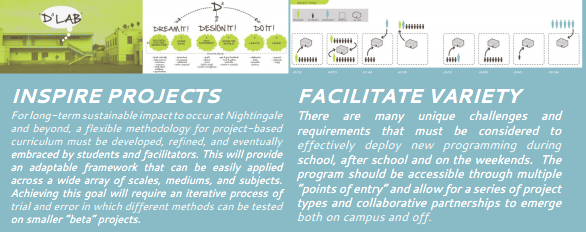
Tour with Nancy Chou in the D3 Lab: Dream it, Design it, Do it.  New Learning Institute  
Interview with Erin Brest, a musician who graduated from Frida Kahlo High School.

=============
Conversation part 3
The students will put a smile on people's faces. They prepare to visit a local convalescent home. (Music)
The Night Hawk's Nest, made with discarded materials.
"The children have taken ownership of this area."

====== 
Conversation part 4
"Kids learn about safety and they can apply the skills that they learn from other subjects." 
The kids are engaged here. We're preparing them to be citizens of the world. 
Around us there is poverty and hunger, but the answer is in the schools, where they can develop their thinking. 
Thanks to Elliot Washer, Nancy Chou and the staff at Nightingale middle School, who want us to become the best school in the nation. Let's be a model, here's an alternative, please consider it.
Fourth and final part of a candid conversation about education, community and life with Enrique Gonzalez, Principal of Florence Nightingale Middle School in Los Angeles, California.

Contact Enrique at exg0368@LAUSD.net
Filmed and edited by Erik Friedl   www.Youtube.com/aiglon27

Explanation of the New Learning Institute's interest in Nightingale middle School in Los Angeles
Excerpt:   
The Role of Design Thinking & Digital Media Tools
At the D3 Lab at Nightingale Middle School, students learn by doing. We ask them to solve a problem by first defining what the problem is. Students start outside of the space - in the school or in the community - where they ask critical questions that uncover real human needs they want to address. They then iterate to develop an unexpected range of possible solutions and create rough prototypes to take back out into the field to test and retest with real people. The final design is actualized at the school or in the community. The focal points throughout this process are reflection, action, and contribution.
38 MB report about the project

Mentors On Video and the Role of Neighbors in the Community School


I am a high school teacher.  I look for "virtual mentors" for students.  What I see a student who is bored with school work or who wonders "How does this math connect with real life?"  I like to ask the student to contact a mentor ...  usually just by email.   The student then asks, "What 

I also have  www.MentorsonVideo.org which is a way for you to interact with the world's teenagers.  You can say on camera what you find interesting about your work and how school did (or didn't) help you find your passion.   

Can you become a virtual volunteer?  Please!  Write to TLASTEVE@gmail.com and learn more about the process -- you canask a teenager to visit your website and make recommendations for improving its appeal to younger people (you could have parallel sites set up for describing your services and industry to pre-teens and teenagers) and kids can click on your Facebook page, tweet about your site and increase your Klout. 

PHOTO:  Mr. Mario Llorente, a passionate principal, is a mentor to dozens of students.
The shirt "Palabra" is a project associated with Frida Kahlo High School, which Enrique Gonzalez coordinated.  Gonzalez is working with New Learning Institute to create effective relationships between schools and surrounding neighborhoods.   These neighbors are part of the social support network described in the report (38MB) downloadable at this LINK
Learn more by contacting  EXG0368@lausd.net

These two efforts are ways for us to encourage tomorrow's workers to apply themselves a bit more ...  their success will help our retirement!

If you would like to become a mentor on video, let me know.  You can see example videos at http://www.youtube.com/mentorsonvideo 

Our school needs mentors - YouTube

REFERENCE:

Tuesday, November 22, 2011

What if we shared ideas worth sharing with each other? What if we recommended more विडोस...

What if we shared ideas worth sharing with each other? What if we recommended more videos to each other and colleagues?
Some of the youtube videos I've listened to lately have me thinking about the future.

What is social learning?
http://www.youtube.com/watch?v=NIlwGYY0_AA
what gutenberg did for written word, social media did for the spoken word...
fusion-universal for social learning

http://www.youtube.com/watch?v=9HYYWK453g0
fusion virtual school in KENYA


attendance ... email to student "you are absent"
i care that you are here
http://www.youtube.com/watch?v=YROSBbQO70E


creating nearly free textbooks
Flat World world class content
http://www.youtube.com/watch?v=XWcH5LDlcSg
While the disruptive power of the Internet promises wider access to knowledge and new legal licensing structures open the door for enhanced sharing, old business models often stand in the way. How have we arrived at the era of the $200 textbook, with stakeholders so enmeshed in the status quo that they don't seem to question it - even though none of them are being particularly well served? And how can new business models bring disruptive innovation to educational publishing, building a sustainable, new, 21st-century publishing model, based on free and open textbooks, in the process? This paper will explore these questions, offering new perspectives on the future of academic publishing.

Jeff Shelstad is co-founder and CEO of Flat World Knowledge, a venture-backed higher education content company offering world-class, free, and openly-licensed college textbooks. Flat World Knowledge has raised over $25 million in private investment capital since February of 2009, setting out to disrupt the $9+ billion textbook market with its innovative business model


====


http://www.youtube.com/watch?v=Gu06K71JayE

flatworld knowledge youtube channel


the quote by Dr. Simonson from his 2005 book
https://sites.google.com/site/eddsteve2011/quotes-for-instructional-technology


When teachers try to make instruction equal for all students, they will fail. Rather, the teacher should provide a wide
collection of activities that make possible equivalent learning experiences for students using approaches that recognize
fundamental differences between learners, distant and local. Equivalence is more time-consuming and difficult, but promises to be more effective.

Michael Simonson, Trends and Issues in Distant Education: International Perspectives, page 285

------------


Maria Andersen's youtube posts about "Learn this" individualization of learning
http://www.youtube.com/watch?v=m5kAOE3x1aY


Maria Andersen's Free range Learning from TedX
http://www.youtube.com/watch?v=mWdSz2nHQNY

http://www.youtube.com/watch?v=9qiNiwUdmb4

general interview with Maria Andersen


http://www.youtube.com/watch?v=YQGk-ak1dbQ
levers of change for education


edgeoflearning.com
Lift Institute
http://www.youtube.com/watch?v=I9Fj4uspgj
Vision of education where we could go

Molinari's digital divide solution (not one laptop per child, but rather a myriad of computer centers with supportive training)
http://www.youtube.com/watch?v=kaxCRnZ_CLg


http://www.youtube.com/watch?v=NS2PqTTxFFc
he uses a word... soporific...
the formulation of the problem or question is more important than the solution ... 7 global skills (Tony Wagner)

Linda Darling-Hammond
http://www.youtube.com/watch?v=9DuW5gGN0_0
Stanford School Design Network


What are scientists? Curious
Cornerstone 2011 - Dr. Autumn Sutherlin - Week 3
From: ACU | Sep 28, 2011 | 97 views
Our world is dominated by fact-based inquiry. At the heart of scientific discovery is the gathering of evidence from experiments; and it is the ability to repeat those experiments with the same results that helps formulate facts, which in turn allows for future experiments to happen. What science offers is an objective view of the world, unclouded by emotion or perspective or interpretation. But what happens when scientists dispute the "facts"? Is there room for interpretation, and if so, does that lead us down a slope of "my point of view" versus "your point of view"?

http://www.youtube.com/watch?v=tSREHEqBSZc


ACU and mobile learning university in Abilene
http://www.youtube.com/watch?v=स्श्रा६४१ओक५

ACU and mobile learning university in Abilene
http://www.youtube.com/watch?v=sSPA641oc5Q


माय My blog has been taken over by thai or maybe hindi?

Monday, November 7, 2011

Announcing a HALL OF FAME for Instructional Technologists


I'm in a program at Nova Southeastern University and one of our assignments is to identify nomineees for a "hall of fame" of instructional technologists.

<<< Here's my nominee.


You can learn more at

the HALL OF FAME (this is a proposed website... with proposed nominees, with work by my classmates).


A recipe for do-it-yourself learning...


This week's post is about FREE RANGE LEARNING. A delightful "recipe" for learning in a random, "follow your heart" way is described on Youtube.com.

"outside the mainstream"
DIY learning vs. evil caged learning?
highly structured education that takes place with "somewhat captive" participants

============================

What does it take to become a successful learner...
(summary of her talk):
We need a recipe...
a) information (high quality ingredients)
b) we need a set of directions -- we need to reengage
c) we need to reflect (writing) ... blogging is a form of learning -- when we write about something, we eventually stumble on our words in a previous blog.
d) (space for reflection) white noise helps us reflect... we need space for brain to relax and -- procedure, tell your brain to focus on a problem...
e) spices to make food more enjoyable, so we need spice to learning by engaging in social activities... join the right social network or go to a conference -- standing appointment once a week -- learn a language by talking -- how about twitter in another language?
"when someone tweets about a new game design, i get excited about it and reconnected to my area of interest."
f) Get variety -- humans can provide new resources.
g) cook time: 10,000 hours... structure
h) we need a way to deal with decision fatigue... paralyzed by too many
A guy named Eddinghouse is important...
each reengagement helps you store the info in biological information...
i) Set a learning challenge that is hard to postpone
Set a presentation date... pressure to make sure I learn everything I can about a topic.

To learn Spanish, buy a non-refundable plane ticket to Spain 9 months from now.

What happens during a dissertation?
classes stop, assignments stop, tests stop. It's up to you to write about a topic of your own choosing.

40-70% of Ph.D. don't complete their dissertation within 7 years... (depending on the degree specialization)
good learners, but unable to progress with a free range project.
Have you learned how to learn on your own?

How do you eat an elephant?... one bite at a time.

We need to apply this recipe with students...
For example, a documentary had the following line: The US produces more trash than two Chinas or 15 Indias.

So I did a search and learned that the USA in 2009 produced 230 million tons of trash. Assume 310 million people ... how much trash per person?

In China, how much trash per person?
In India, how much trash per person?

None of these thoughts were explicitly given in the documentary. But we can then go farther... "the U.S. is xx% of the world's population, but the nation produces xxxx% of the world's trash."

It's all part of "learning the global skills" and integrating the subjects to analyze a situation.


Please send comments to VisualandActive@gmail.com